Anyone who works in IT knows this well: there is never really a moment when you can say “now I know everything I need”.
Technologies, tools and development practices change constantly. Some innovations arrive and disappear within a few years, while other technologies remain at the foundation of the Web and continue to deserve attention, study and, above all, practice.
This is the case with HTML5, CSS3 and Bootstrap.
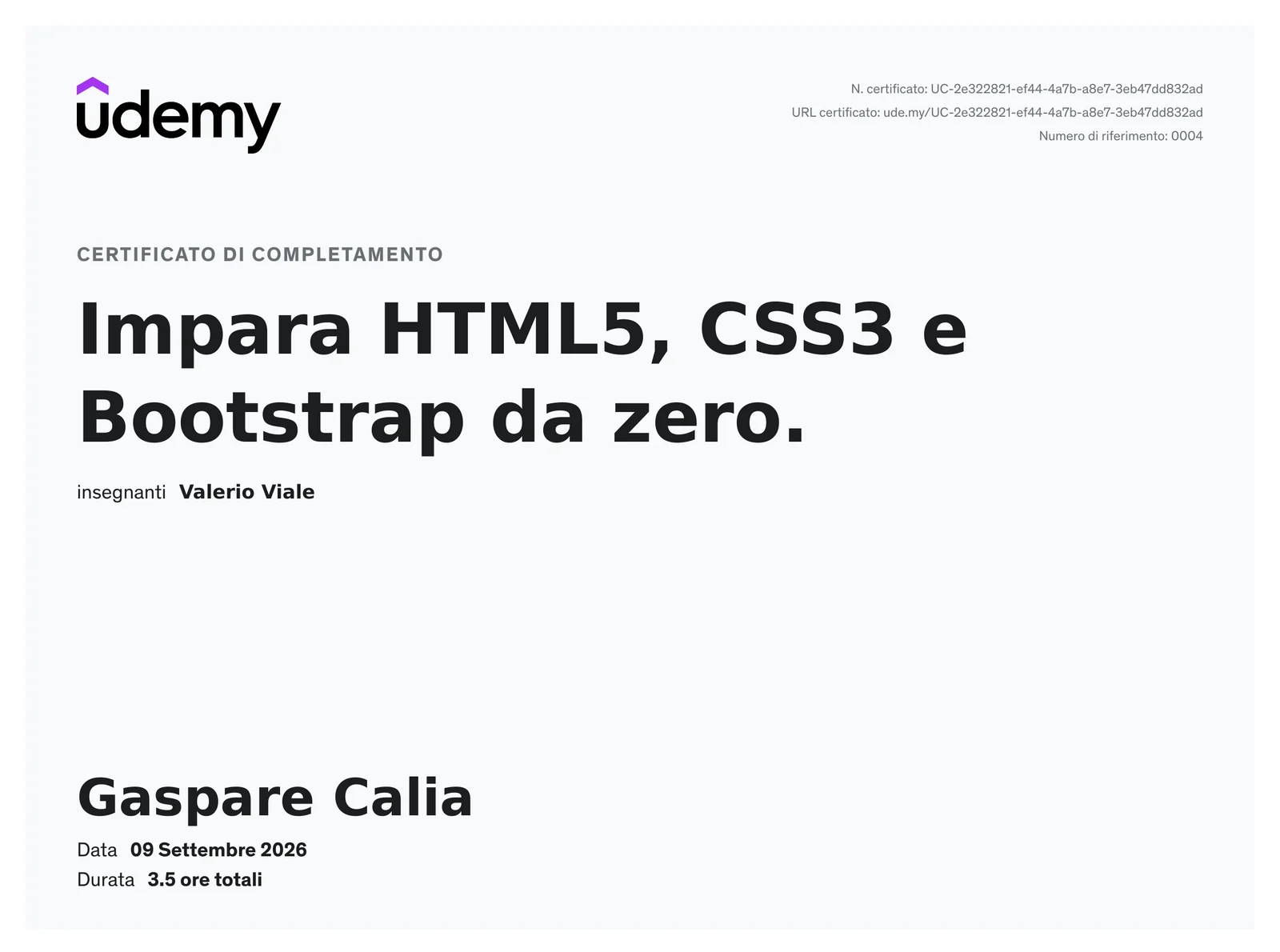
On September 9, 2026, I completed the Udemy course “Learn HTML5, CSS3 and Bootstrap from scratch”, taught by Valerio Viale, receiving the corresponding certificate of completion after a 3.5-hour learning path.
However, I do not see this kind of certificate as a finish line.
I see it instead as one of the small milestones in a much longer journey.
Going back to the fundamentals is always useful
When you work every day with software, databases, Python, APIs, artificial intelligence and increasingly complex applications, it may seem strange to spend time again on the fundamental technologies of the Web.
In fact, the opposite is true.
HTML defines the structure and meaning of content.
CSS determines how that content is presented and adapted to different devices.
Bootstrap makes it possible to build responsive and consistent interfaces quickly, providing a solid foundation of components and layout tools.
Frameworks, libraries and complex systems may change, but understanding what happens underneath makes it possible to use them with greater awareness.
Knowing “how to do it” is not enough
This is a distinction that is becoming increasingly important to me.
We can learn to copy a component, use a CSS class or insert a Bootstrap element and immediately obtain something that works.
But there is a big difference between:
knowing which command to use
and
understanding why that command produces that result.
It is precisely this second ability that then makes it possible to solve new problems.
And it is also one of the reasons why I continue to study tools that I have already been using for a long time.
Whenever you return to a subject with more experience, you discover details that had gone unnoticed the first time.
From training to real projects
Study gains value above all when it is applied.
In the daily work of Calia Software, HTML, CSS and Bootstrap are not theoretical topics: they are continuously involved in the creation of websites, interfaces, management panels and Web applications.
A responsive layout, a page that remains readable on a smartphone, an easy-to-use form or a clear interface do not come from aesthetics alone.
They come from the meeting of technology, design and attention to the people who will use the product.
For this reason, even a short learning path can become an opportunity to review the way we work and improve it.
Does artificial intelligence make studying HTML and CSS unnecessary?
It is an interesting question, especially today.
Artificial-intelligence-based tools are now able to generate code, rapidly create prototypes and suggest solutions in just a few seconds.
But precisely for this reason, knowing the fundamentals becomes even more important.
If we do not understand the generated code, we are not really able to determine whether it is correct, accessible, secure, efficient or simply suitable for the project.
AI can become an extraordinary collaborator.
But the ability to evaluate what it produces remains human.
And that ability also comes from study.
Continuous learning, without collecting certificates
A certificate of completion is certainly satisfying.
But its value is not in the document itself.
The value lies in what remains after the course: a technique understood better, a new solution, an old habit questioned, or simply the curiosity to explore further.
This is the principle I would like to continue bringing into Calia Software projects and training activities:
learn, experiment, build, make mistakes, correct them and start again.
Because in IT, perhaps more than in many other fields, stopping learning sooner or later means stopping evolving.
And I prefer to remain curious. 😊