Coding can be much more than a programming course. With thoughtful educational mediation, it can become a tool that helps children observe, plan, control impulsivity, formulate hypotheses, check results and correct themselves.
This is where the Feuerstein Method and Scratch can meet: not because they are the same thing, but because both can place the child’s thinking process at the centre, rather than focusing only on the final result.
Feuerstein: learning how to learn through mediation
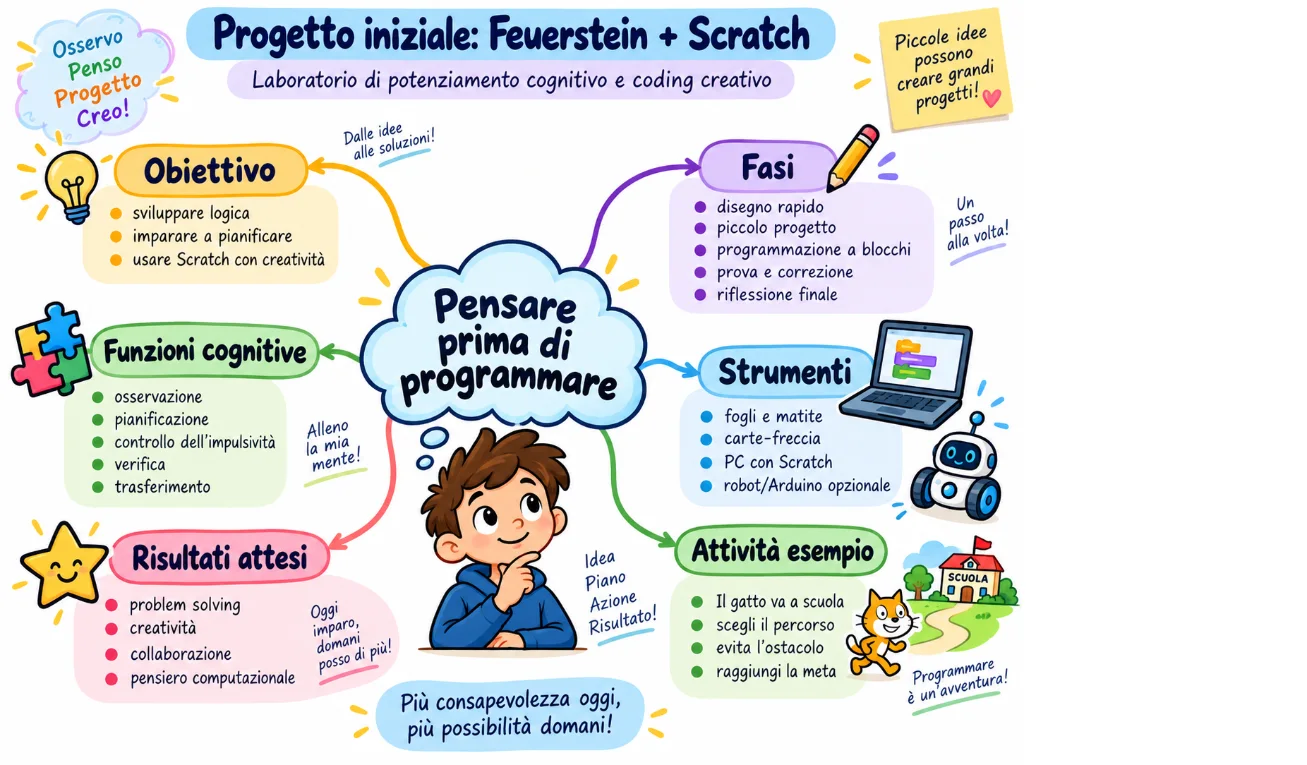
The Feuerstein Method is a process-oriented approach to cognitive modifiability. The Feuerstein Institute describes it as a method that teaches people how to learn how to learn through the Mediated Learning Experience (MLE): the teacher does not simply provide an answer, but mediates the experience and helps the learner understand how information is being collected and used.
In practice, the work may involve observing, gathering information, planning, controlling impulsivity, formulating hypotheses, checking, correcting and transferring a strategy to new problems.
Scratch: design, test, debug and try again
Scratch engages several compatible processes: breaking a problem into parts, designing a solution, building it, testing it, finding what does not work, changing it and trying again. The Scratch Foundation describes its creative learning philosophy in terms of problem solving, decomposition, debugging, iteration and reflection.
This does not mean turning Feuerstein into a coding course. It means using Scratch as one of the tools through which thinking processes can become visible.
What research tells us
A 2026 systematic review in the Journal of Computer Assisted Learning analysed 46 empirical studies on the use of Scratch in K-12 education to develop computational thinking. It highlights the importance of structured activities, gradual scaffolding and age-appropriate tasks, while reducing simple trial-and-error approaches.
A 2024 study entitled Teacher Mediation in Coding Activities examined teacher mediation during a coding activity with five-year-old children and explicitly connected the discussion with Feuerstein’s theory of mediated learning.
Research on unplugged activities is also relevant. A systematic review and meta-analysis of 49 K-12 studies found a generally large overall effect on computational thinking. Another review and meta-analysis published in 2024 on the cognitive effects of coding found the strongest effects on problem solving and smaller but significant effects on planning. The same work suggests that structured virtual activities and educational robotics are especially useful for younger children, while older learners can benefit from more open virtual coding activities, including Scratch-based work.
A possible sequence for children around 8-12
FEUERSTEIN → UNPLUGGED → SCRATCH → REFLECTION
The idea is simple: before opening the computer, work on the problem and on the way to approach it. Only afterwards move to Scratch blocks.
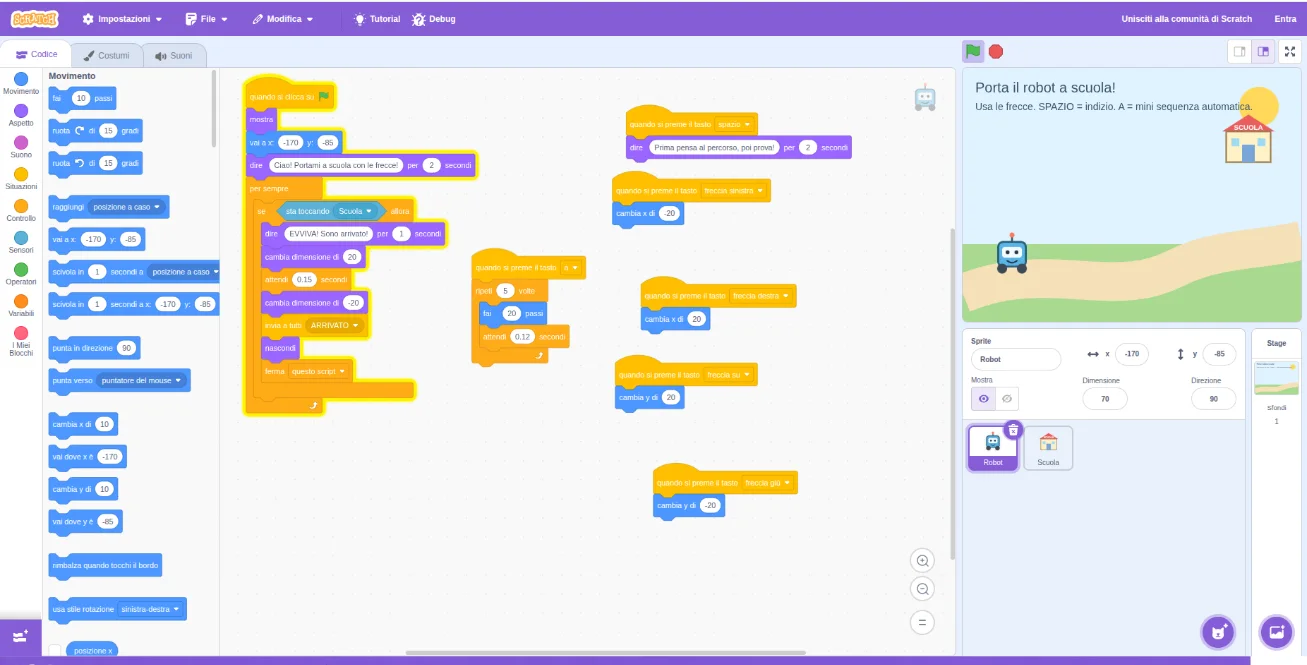
A concrete example: the cat has to reach school
Give the child a short story:
“The cat has to reach the school, but there are three crossroads on the way.”
At first, no computer. The mediator may ask:
- What is the goal?
- What information do we have?
- What do we need to know before we start?
- Can we divide the problem into smaller parts?
- What do you predict will happen?
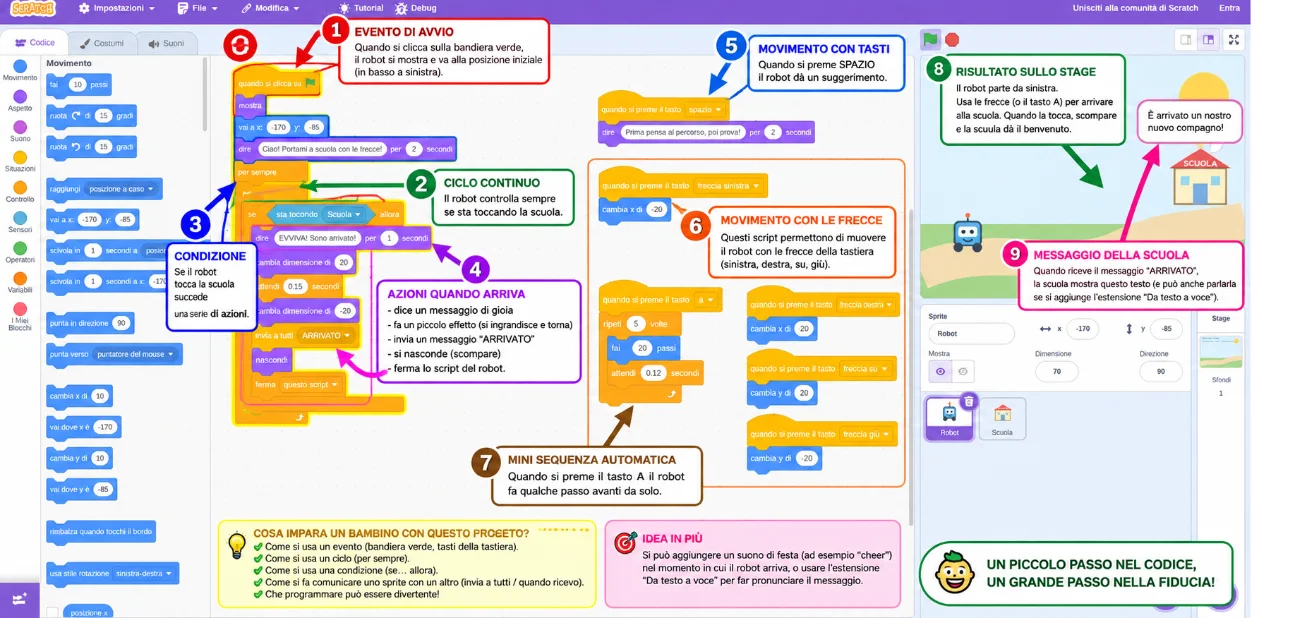
Only then do we open Scratch and build the solution.
If something does not work, instead of immediately saying “You used the wrong block”, we can ask:
- What did you think would happen?
- What happened instead?
- Where can we look for the difference?
- How can we check it?
Debugging then becomes more than correcting code: it becomes an opportunity to make reasoning explicit.
The final question: transfer the strategy
At the end comes the question that is closest to the Feuerstein spirit:
“Where else, outside Scratch, could we use this strategy?”
This is the point at which coding can become a cognitive-development tool rather than merely a sequence of blocks to memorise.
And for younger children?
For preschool and the first years of primary school, Bright Start may also be interesting. It is an early cognitive education programme through play, developed by Carl Haywood, whose theoretical foundations also draw on Feuerstein’s contributions. It works on logical thinking, problem solving, self-control, motivation and metacognition.
A possible progression, always to be adapted to the children and context, could be:
- Ages 5-7: play and unplugged activities + Bright Start-inspired work + ScratchJr or simple robots;
- Ages 8-12: Feuerstein + unplugged + Scratch;
- later: Scratch + educational robotics or micro:bit.
In this framework Scratch is not the final goal. It becomes one useful tool for learning to think, plan, test and reflect.
Try the Scratch project
You can view and try the small project used in this example directly on Scratch:
Open the “cat/robot reaches school” Scratch project
Sources and further reading
- Feuerstein Institute — The Feuerstein Method
- Scratch Foundation — Creative Learning Philosophy
- Scratch Foundation — Debugging
- Sun, Wang & Wei (2026) — Teaching Computational Thinking Skills Through Scratch in K-12 Education
- Granone (2024) — Teacher Mediation in Coding Activities
- Chen et al. — Unplugged computational thinking: systematic review and meta-analysis
- Montuori et al. (2024) — The cognitive effects of computational thinking
- Bright Start — early cognitive education through play